SCR vs BJT vs MOSFET: Key Differences, Working Principles and Applications
- Electronics & Semiconductors
- (Asia/Kolkata)
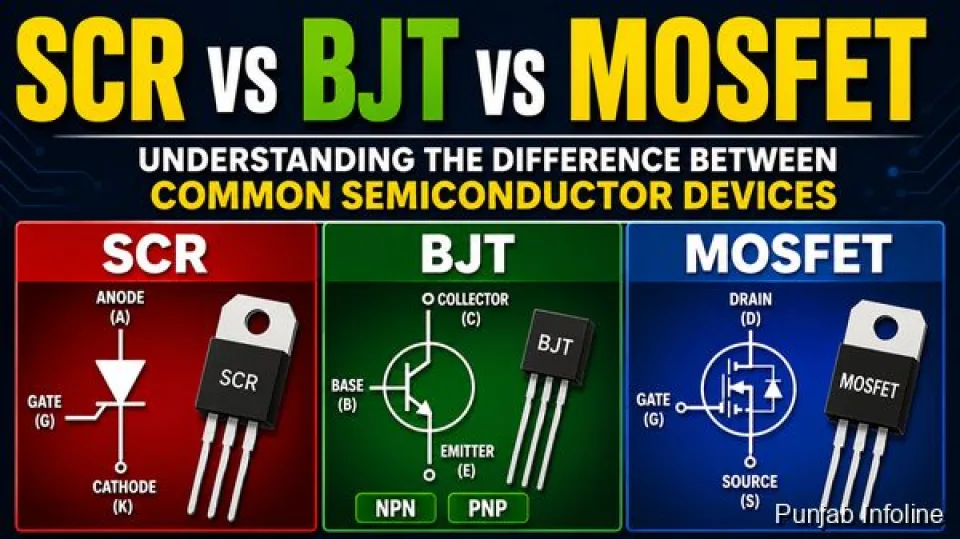
Modern electronic circuits rely heavily on semiconductor devices for switching, amplification and power control. Among the most commonly encountered devices are the SCR, BJT and MOSFET.
Beginners sometimes compare “SCR vs BJT vs MOSFET vs transistor,” but there is an important distinction to understand first:
BJT and MOSFET are both types of transistors, while an SCR belongs to the thyristor family.
Understanding how these devices work and how they differ makes it much easier to select the correct component for an amplifier, power supply, motor controller, inverter or other electronic circuit.
What Is a Transistor?
A transistor is a semiconductor device primarily used for switching and amplification.
Two major transistor families are:
- BJT — Bipolar Junction Transistor
- FET — Field-Effect Transistor
MOSFET stands for Metal-Oxide-Semiconductor Field-Effect Transistor, making it a type of FET and therefore a type of transistor.
A simplified classification is:
Transistors
- BJT
- FET
- JFET
- MOSFET
An SCR, however, belongs to another semiconductor family:
Thyristors
- SCR
- TRIAC
- GTO
- Other thyristor devices
Therefore, technically, the most useful comparison is SCR vs BJT vs MOSFET.
What Is a BJT?
BJT stands for Bipolar Junction Transistor.
A conventional BJT has three terminals:
- Emitter
- Base
- Collector
The two basic types are:
- NPN
- PNP
A BJT is fundamentally a current-controlled device. A relatively small base current can control a considerably larger collector current.
In simplified terms:
Small Base Current → Controls Larger Collector Current
This characteristic allows BJTs to work both as electronic switches and as amplifiers.
Common Uses of BJTs
BJTs are widely used in:
- Audio amplifiers
- Signal amplification
- Switching circuits
- LED drivers
- Relay drivers
- Oscillators
- Analog circuits
- Power-control circuits
For example, a small current coming from a control circuit can drive the base of a BJT, allowing the transistor to control a larger load current.
What Is a MOSFET?
MOSFET stands for Metal-Oxide-Semiconductor Field-Effect Transistor.
Its three main terminals are:
- Gate
- Drain
- Source
A fourth terminal called the body or substrate also exists physically, although in discrete MOSFETs it is commonly internally connected to the source.
Unlike a BJT, a MOSFET is primarily a voltage-controlled device.
In simplified terms:
Gate Voltage → Controls Drain Current
The insulated gate gives the MOSFET very high input impedance. Ideally, almost no steady-state DC current flows into the gate.
However, the gate has capacitance. During switching, this capacitance must be charged and discharged, so a practical MOSFET gate driver may need to provide substantial short-duration current for fast switching.
Common Uses of MOSFETs
MOSFETs are extremely common in modern electronics, including:
- Switching power supplies
- DC-DC converters
- Inverters
- Motor controllers
- Battery-management systems
- Solar power systems
- LED drivers
- Automotive electronics
- Computer motherboards
- Digital integrated circuits
MOSFETs are particularly attractive for applications requiring efficient and fast electronic switching.
What Is an SCR?
SCR stands for Silicon Controlled Rectifier.
It belongs to the thyristor family rather than the transistor family.
An SCR has three terminals:
- Anode
- Cathode
- Gate
Its behaviour is quite different from that of a normal BJT or MOSFET.
When the SCR is forward biased, an appropriate pulse at the gate can trigger it into conduction.
The important characteristic is that the SCR latches ON.
Once sufficient current is flowing through the SCR, removing the gate signal normally does not switch it off.
It remains conducting until its current falls below a particular level known as the holding current, or until external circuitry forces the current low enough to turn it off.
This makes an SCR particularly useful for controlling substantial electrical power.
Common Uses of SCRs
SCRs can be found in:
- Controlled rectifiers
- Industrial power controllers
- Battery chargers
- Motor-speed controllers
- Heating controllers
- High-power switching systems
- AC power-control circuits
- Soft starters
- Crowbar overvoltage-protection circuits
SCR vs BJT vs MOSFET
The fundamental differences can be summarised as follows:
- Device family: SCR — Thyristor; BJT — Transistor; MOSFET — Transistor/FET
- Main terminals: SCR — Anode, Cathode, Gate; BJT — Collector, Base, Emitter; MOSFET — Drain, Gate, Source
- Basic control: SCR — Gate trigger; BJT — Base current; MOSFET — Gate voltage
- Latching behaviour: SCR — Yes; BJT — No; MOSFET — No
- Amplification: SCR — Not normally used for it; BJT — Excellent; MOSFET — Yes
- Switching speed: SCR — Generally lower; BJT — Moderate; MOSFET — Generally high
- Input/control requirement: SCR — Trigger pulse; BJT — Continuous base drive while ON; MOSFET — Gate charge/voltage
- High-power applications: SCR — Excellent; BJT — Good; MOSFET — Excellent in suitable voltage ranges
- Easy electronic turn-off: SCR — Not for conventional SCR; BJT — Yes; MOSFET — Yes
- Common role: SCR — Power control; BJT — Amplification/switching; MOSFET — Efficient high-speed switching
The Most Important Difference: How They Are Controlled
A simple way to remember these devices is:
BJT — Current Controlled
A BJT requires base current to control the collector-emitter current.
Base Current → Collector Current
MOSFET — Voltage Controlled
A MOSFET is controlled primarily by the voltage between its gate and source.
Gate Voltage → Drain Current
SCR — Triggered and Latched
An SCR receives a gate trigger to turn ON and then remains conducting while sufficient anode current continues flowing.
Gate Pulse → ON → Remains ON until current falls sufficiently
This latching characteristic is one of the biggest differences between an SCR and a transistor used as a conventional switch.
Simple Switch Analogy
Imagine that all three devices control a lamp.
BJT
The BJT behaves somewhat like a switch that requires a continuous control current.
Remove the required base drive and the transistor switches off.
MOSFET
A MOSFET behaves like a switch controlled by voltage.
Apply the appropriate gate-to-source voltage and it turns on. Remove the drive and discharge the gate, and it turns off.
SCR
An SCR behaves more like a latching switch.
Give it the required gate trigger and it switches on. Removing the gate signal does not necessarily switch it off.
The current through the SCR must fall below its holding level before it returns to its blocking state.
Why Are MOSFETs So Popular in Modern Switching Circuits?
MOSFETs offer several advantages for electronic switching.
They can provide:
- Very fast switching
- High input impedance
- Low control power in steady state
- Low conduction losses when an appropriate low-RDS(on) device is selected
- Easy interfacing with electronic control circuits
- High switching frequencies
This is why MOSFETs are frequently found inside SMPS power supplies, DC-DC converters, battery systems, motor controllers and inverters.
However, selecting a MOSFET requires more than checking its current rating.
Important parameters include:
- Drain-source voltage rating
- Continuous and pulsed drain current
- RDS(on)
- Gate threshold voltage
- Required gate-drive voltage
- Total gate charge
- Switching losses
- Junction temperature
- Thermal resistance
- Safe Operating Area (SOA)
The gate threshold voltage should not be confused with the voltage required to turn the MOSFET fully on. This is an especially important point when designing practical circuits.
When Is a BJT Better?
MOSFETs have become dominant in many switching applications, but BJTs remain highly useful.
A BJT can be a good choice for:
- Analog amplification
- Audio circuits
- Small signal circuits
- Simple low-cost switching
- Constant-current circuits
- Linear circuits
BJTs have predictable transconductance characteristics that make them particularly valuable in analog circuit design.
When Is an SCR Better?
An SCR becomes attractive when the application involves high electrical power and latching operation.
For example, consider AC power.
The current naturally passes through zero every AC cycle. Because an SCR can turn off when its current drops below its holding current, this natural current zero can be used in power-control systems.
By changing the point in the AC cycle at which an SCR is triggered, the amount of power delivered to a load can be controlled.
SCRs therefore remain important in industrial power electronics despite the widespread use of modern power transistors.
SCR vs MOSFET: Which Is Better?
Neither device is universally better. The correct choice depends on the application.
A MOSFET is generally more appropriate when you need:
- Fast switching
- High switching frequency
- Straightforward electronic ON/OFF control
- PWM control
- DC-DC conversion
- Efficient low- and medium-voltage switching
An SCR may be more appropriate when you need:
- Very high-power control
- Latching operation
- Controlled rectification
- Certain AC or industrial power-control applications
They solve different engineering problems.
BJT vs MOSFET: Which Is Better?
For many modern switching applications, MOSFETs offer significant advantages because they are voltage-driven and can switch very quickly.
For analog amplification, however, BJTs remain extremely important.
A simplified rule for beginners is:
Amplification → BJT or MOSFET
Fast electronic switching → MOSFET
High-power controlled rectification/latching → SCR
This is only a general guideline. Actual component selection must consider voltage, current, switching frequency, losses, temperature, cost and circuit topology.
Easy Way to Remember
Remember these three sentences:
BJT = Control it with current.
MOSFET = Control it with voltage.
SCR = Trigger it, and it latches ON.
That simple distinction explains much of the practical difference between these semiconductor devices.
Conclusion
SCRs, BJTs and MOSFETs are all important semiconductor devices, but they are designed around different operating principles.
A BJT is a transistor in which base current controls collector current, making it useful for both amplification and switching.
A MOSFET is a field-effect transistor controlled primarily by gate-to-source voltage. Its high input impedance and fast switching capability have made it one of the most widely used devices in modern power and digital electronics.
An SCR is a thyristor designed primarily for controlled power switching. Its distinctive feature is its ability to latch into the conducting state after being triggered.
Therefore, rather than asking simply which device is “best,” electronics designers ask:
What voltage, current, frequency, efficiency, control method and switching behaviour does the circuit require?
The answer to those questions determines whether a BJT, MOSFET, SCR or another semiconductor device is the right choice.